


Alas, the United States has gone off the deep end with AI fear. This month alone, there has been a notable burst of warnings about the “dangers” of AI from the very people building, financing, and championing it. It seems like everyone—current and former lab employees, CEOs, and rich tech futurists—is now saying, “It’s going to kill our jobs, our environment, and us. We need to stop it NOW!”
For example, in the span of just one week, Anthropic alignment science lead Evan Hubinger asserted that AI could “kill all humans,” putting his publicly stated subjective probability at greater than 10 percent within the next decade; newly appointed OpenAI nonprofit board member Paul Christiano warned that, without better alignment, “most people could die,” and estimated the risk of catastrophe at 4 percent within one year; and, at an event on Tuesday, OpenAI CEO Sam Altman mentioned a possible “loss of control accident” and AI companies accumulating excessive power.
Unsurprisingly, the anxiety is measurable among the public: A new Pew survey found that 52 percent of Americans are more concerned than excited about the increased use of AI in daily life, up from 37 percent in 2021. And for the first time, a majority of young adults under 30 say they’re more concerned than excited. Job loss remains a major source of that fear, with 71 percent of adults believing AI will lead to fewer U.S. jobs over the next 20 years.
Giving in to such irrational fears is anti-progress and will mean a worse America, not a better one.
To be sure, a multitude of pundits, “civil society” groups, and politicians have jumped on the bandwagon; many of them are congenital opponents of technology and business who oppose AI simply because it is the latest and greatest thing.
Twenty years ago, these types warned that RFID chips could become the biblical “mark of the beast.” (One of the leading proponents of that absurd campaign later received enormous credibility, including a byline in Scientific American, a journal that used to stand for objectivity.) AI fearmongering makes those RFID claims look mild by comparison.
The reality is that these neo-Luddites are a permanent feature of the techno-economic policy landscape. What is different now is the rise of individuals who promote transformational AI narratives, many of them dystopian, and then have the gall to complain that too many Americans fear AI.
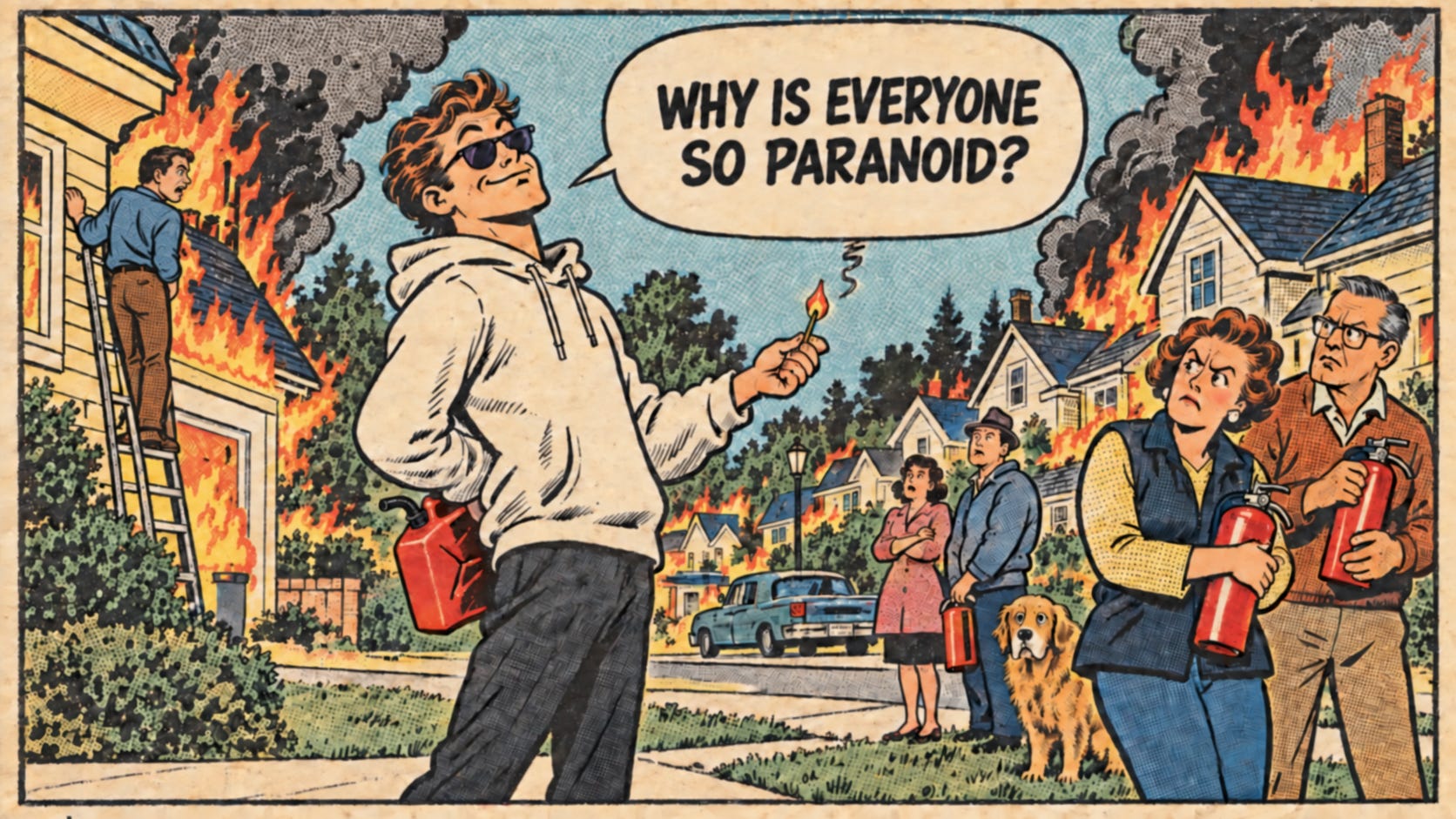
This is like an arsonist complaining that the neighborhood has gotten paranoid about fire.
Speaking at Salesforce’s Dreamforce conference on Tuesday, Altman warned that AI companies could accumulate excessive power and said, “The world is right to be afraid of this.” He then asked the public to trust that AI companies would “do the right thing.” Got that? The leader of one of the most prominent AI companies tells the public it is “right to be afraid,” then asks it to trust that the industry will behave responsibly. So, should the public be afraid or trusting?
Those warnings may be sincere. But when people advancing and championing AI talk this way, the industry cannot act surprised when the public takes them seriously or when politicians turn that fear into calls to halt the technology.
Case in point is billionaire and prominent AI booster Vinod Khosla, whose firm was the first venture capital investor in OpenAI. Earlier this year, Khosla stated that 80 percent of jobs will be AI-capable and open to displacement by 2030: “Will there be new kinds of jobs? Maybe, maybe not. I don’t know. There’s very few things AI won’t be able to do today in next few years. So I do think we ought to structurally solve this problem by increasing the minimum level of services.”
Then, with zero sense of irony, he went on to say, “I think the single biggest danger to AI is not AI capability or lack thereof. The single biggest danger to AI adoption is politics.” He continued by arguing that Americans shouldn’t fear AI but should instead consider its endless possibilities, offering a positive example: “The U.S. could develop a free doctor and offer it to everybody on the planet. That’s a project doable in the next two, three years.”
Just this week, Khosla published an article that once again predicted large-scale AI-driven unemployment, citing eye-popping estimates and saying he’s “as certain as I’ve been about anything.” The article proposes changes to U.S. policies and institutions to prepare for this scenario. It includes some fairly reasonable statements, including calls to “protect people and transitions, not necessarily existing jobs” and “maintain a strong safety and security posture while holding on to a lead against our AI nation-state adversaries.”
He ends by stating, “Preserving public support for AI requires giving people security.” Well, perhaps if you, Vinod, didn’t scare the bejesus out of people with attention-grabbing, economically illiterate claims about job loss, people would be less scared and more willing to accept AI.
This “be terrified but don’t be” narrative is now standard fare among tech bros.
Tech futurist Peter H. Diamandis, who describes himself as a “data-driven optimist inspiring entrepreneurs through research, investment & community to create an abundant future for humanity,” tells people not to fear AI. Yet he also talks about humanity splitting into “consumers and creators” based on how they use AI and has said AI will eventually have “the most wisdom of anything, anyone.” Welcome to your benevolent overlord. By the way, stop all that AI fear nonsense.
Mo Gawdat, the former chief business officer of Google X and a tech self-promoter, warned this summer that 30 percent of jobs in certain sectors would disappear by 2028, but also says, “Fear isn’t what we need when it comes to AI, wisdom is.” Clearly, you are short on the latter. Oh, and Mo, want to bet on your job-loss prediction? You have lots of money. How about $1,000?
His book, Scary Smart, warns that “technology today poses an unprecedented threat to our planet and all of its inhabitants” and that machines are dangerous, unmanageable, and “inevitably going to rule our future.” Good stuff for selling books. Not so good for building support for AI.
Can you imagine if, in the early 1900s, Henry Ford and Thomas Edison had touted the transformative power of cars and electricity while warning that these same technologies would kill millions of people, pollute the environment, hollow out cities—and deliver some benefits, too? Adoption would have been slower, regulation more harmful, and the outcome worse for Americans and America.
Of course, tech futurists know they have a good gig: say outlandish BS about AI destruction, and people buy your books, invite you to appear on podcasts and speak at conferences, and quote you in global (and Beltway) outlets. But if you are going to indulge in that kind of self-promotion, could you at least stop preaching that people shouldn’t be afraid? You just make yourself look dumb.
To be clear, this is not an attempt to adjudicate the ongoing AI safety debate. Anthropic CEO Dario Amodei’s recent essay, which drew endorsements from several of his leading competitors, has only intensified that debate. But Amodei is not an example of the hypocrisy I’m describing: Whether or not one agrees with his diagnosis or path forward, his warning is consistent with his proposed response. My point here is narrower.
As I’ve outlined before, efforts to reduce genuine risks and enact policies to help workers displaced by AI successfully transition to new jobs are legitimate and necessary. What is not legitimate or necessary, but is hypocritical, is for tech bros to confidently broadcast speculative, apocalyptic AI scenarios and then bewail the public fear and political backlash they predictably produce.
If AI’s supposed “champions” don’t want people to be afraid, they should stop selling fear.