


History’s leading innovation economist, Joseph Schumpeter, famously coined the term “creative destruction,” arguing that it is the secret to growth and innovation.
He distinguished it from “uncreative destruction,” which might destroy a nation’s productive assets through natural disasters, wars, predatory foreign trade policies (China, I’m looking at you), or broader societal decay and limited reinvestment.
Creative destruction, on the other hand, refers to assets being destroyed, either physically or monetarily, because a more effective and innovative alternative has emerged.
The most iconic example of creative destruction—the transformation of England’s textile industry from a cottage industry—was not driven by war, but by the introduction of cutting-edge machinery, primarily the spinning jenny, water frame, and power loom. These innovations destroyed many rural jobs, but they also significantly improved living standards, allowing ordinary Brits to afford clothing. It also gave us the term “Luddite.”
Likewise, we didn’t lose massive numbers of horses in the early twentieth century because of some equine disease; we lost them because people stopped buying horses and started buying cars.
But a natural reaction to this process, one that’s common in dynamic societies, particularly among people high on the empathy scale (e.g., “Caretakers”), is to ask: Can’t we have growth without destruction? We see this today in debates over AI and robotics, where empathic Caretakers (I’m exempting the pure Luddites from this conversation) want to limit job-replacing technologies and allow only those that complement workers.
To be sure, that would reduce some layoffs, a plus for Caretakers. But it wouldn’t eliminate them. Why would an organization invest in AI, robotics, or any other capital equipment—even if it complements workers—if not to boost production and cut costs? Otherwise, where does the return come from?
That means even worker-complementing technologies will still raise efficiency, just not as much as job-replacing technology, and firms will employ at least somewhat fewer workers. Even if a company could expand its market share without any layoffs, the firms losing that share would have to let workers go.
But the reality, at least to hard-hearted realists (me, I’m looking at me), is that job-replacing technology generates more growth. Would we be richer or poorer if the automatic electric switchboard hadn’t been developed and telephone companies continued to rely on manual operators to connect calls? Would we be richer or poorer if we had given longshoremen better winches instead of adopting the standardized shipping container? Would we be richer or poorer if airline ticket agents had better computers but passengers were not allowed to check in for flights on their smartphones? Hint: poorer.
Given this dichotomy between Caretakers and hard-hearted realists, is there any way to square the circle? Thankfully, there is—if Caretakers are willing to accept some pain and realists are willing to show some compassion. In this ideal world, creative destruction would not be opposed; in fact, it would be encouraged. But individual workers who are hurt would be helped to transition to new opportunities.
Perhaps the closest real-world example to this ideal is found in the Nordic countries. While generally supporting creative destruction (albeit less so than the United States), these nations do an excellent job of helping workers transition between jobs through their “flexicurity” model, which balances flexible hiring and firing rules with generous unemployment benefits and active labor market policies.
It would be nice if we had precise measures of a nation’s acceptance of or resistance to creative destruction. But in their absence, I have sketched the following conceptual framework (see figure 1). The x-axis represents the degree to which countries resist creative destruction, based in part on how difficult it is to fire workers and partly on my admittedly subjective evaluation. The y-axis represents the degree to which countries act as Caretakers (e.g., helping workers transition) versus hard-hearted realists (e.g., leaving workers more on their own), based largely on the share of income replaced for laid-off workers after one year.
So, the farther right a nation is on the x-axis, the more it resists creative destruction. And the higher up a nation is on the y-axis, the more support it provides to workers affected by disruption.
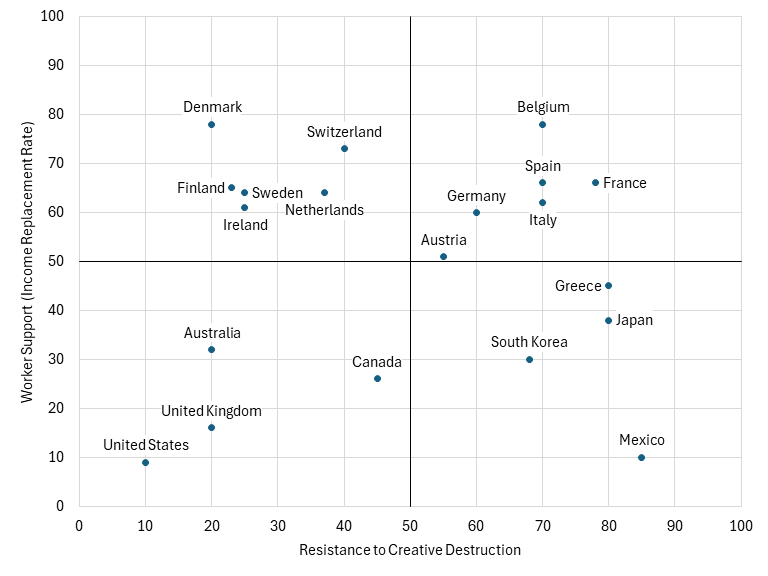
Needless to say, the upper-left quadrant is the place to be: low resistance to creative destruction, high growth, and reduced individual hardship from disruption. Think Denmark, Finland, and Sweden, although rising levels of non-EU immigration are prompting renewed debates about the sustainability of their generous welfare systems. And even though these countries are generally more accepting of creative destruction than their European neighbors to the south, they could still move somewhat closer to the U.S. model.
Nations in the upper right generally resist creative destruction—they would rather generate growth by adding new capacity (e.g., building an R&D lab or a chip fab) than by displacing incumbents (e.g., supporting the taxi industry versus ride-sharing apps)—while still providing generous support to displaced workers. Think Belgium, France, Germany, Italy, and Spain. Unfortunately, these countries, rather than the EU nations in the upper-left quadrant, tend to dominate the European government, which is a big reason EU policy is often hostile to creative destruction.
Countries in the lower left are generally comfortable with creative destruction and typically view workers hurt by it as on their own, providing relatively little support. No advanced economy does nothing to help displaced workers, but many don’t do much, and some do even less than others. Enter the United States. Although Luddite forces are sadly gaining ground rapidly, pushing to move the United States toward the lower-right quadrant (resistance to creative destruction, coupled with low worker support)—or, in some cases, toward the upper right via universal basic income (while still resisting creative destruction)—the current system still leans toward growth first, support second. Other countries here include the United Kingdom, Canada, and Australia.
The lower-right quadrant is arguably the worst place to be, at least in terms of creative destruction. It’s the worst of both worlds: These countries are okay with new technologies, as long as no one loses a job (leading them to resist creative destruction, despite enjoying its outcomes), and they don’t provide much assistance for workers hurt by change. Specifically, when disruption occurs, they provide less support than continental European nations. Think Japan and South Korea.
One final note. It’s not clear that even if the United States significantly improved its system for helping dislocated workers—as ITIF has proposed—the growing, increasingly strident chorus opposing technologically driven creative destruction, particularly from AI and robotics, would suddenly take a breath and quiet down.
I’d like to believe that better support would buy more political tolerance for disruption, but I remain skeptical. Ludditism is just too fashionable and too individually rewarding for its advocates now.
So yes, Congress should move the U.S. worker adjustment system closer to the Nordic model. But at the same time, supporters of growth must be prepared to fight politically, rhetorically, and intellectually to preserve America’s comparative advantage in embracing creative destruction.
Thanks for raising this important issue.
Reducing the job-replacement effect while leveraging AI and robotics is a critical challenge. Worker support should focus on strengthening innate human abilities. As we know, humans possess 52 innate abilities across four categories, many of which remain difficult for AI and robotics to replicate. Besides, these abilities are scalable. By continuously sharpening these abilities, we can sustain the relevance of human roles while progressively expanding the scope of machines. This balanced approach delivers three key benefits: (i) greater efficiency in human work, (ii) expanded roles for AI and robotics, and (iii) more time to reskill workers for transitions into alternative jobs.
Look forward to hearing your observation.