


In his 1841 defining work, German developmentalist economist Friedrich List accused the United Kingdom of hypocrisy. Having built its industrial supremacy behind tariffs, the Navigation Acts, and restrictions on machinery exports and the emigration of skilled workers, Britain began preaching the virtues of free trade at precisely the moment free trade served its interests. List put it plainly:
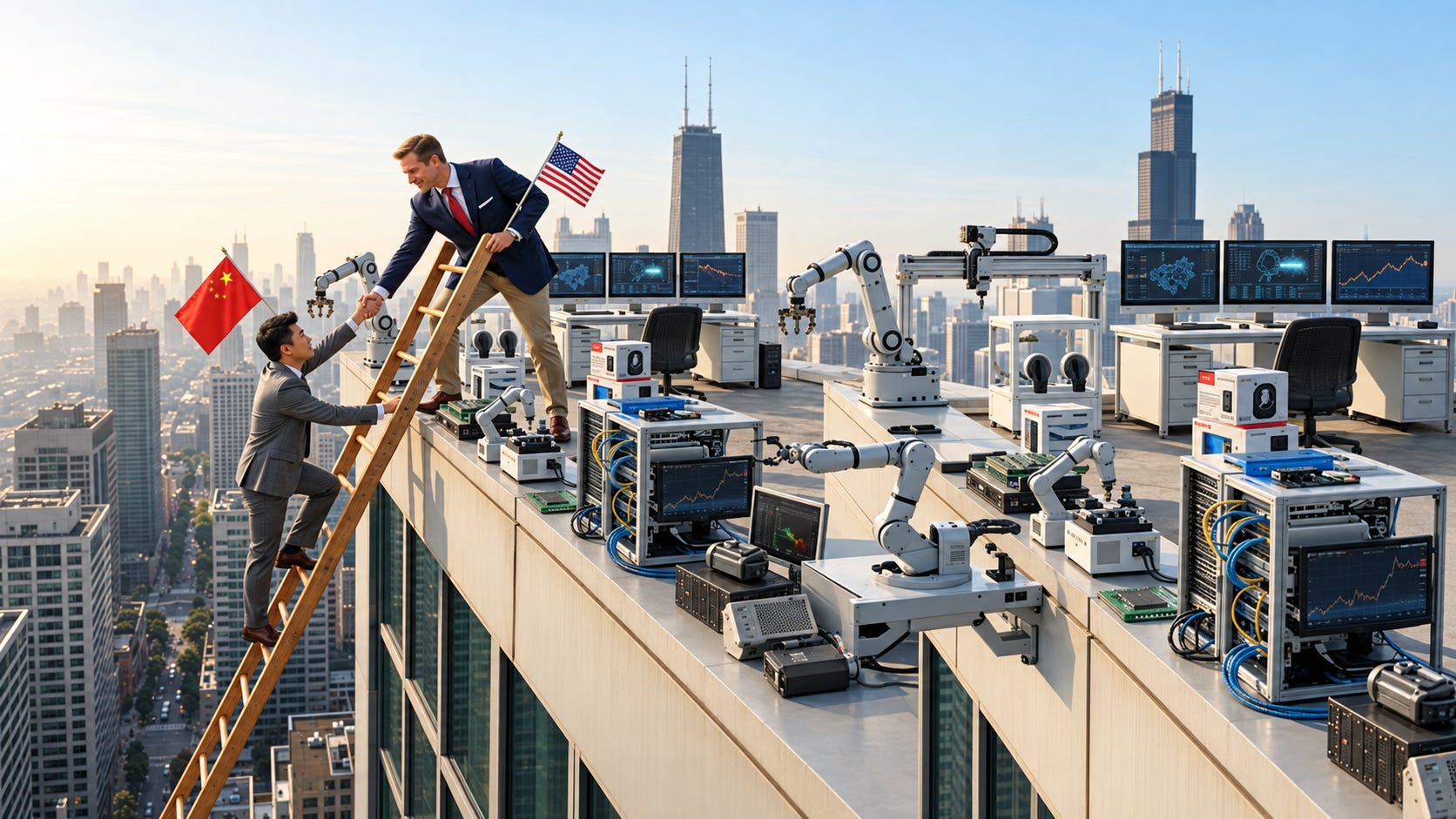
It is a very common clever device that when anyone has attained the summit of greatness, he kicks away the ladder by which he has climbed up, in order to deprive others of the means of climbing up after him. In this lies the secret of the cosmopolitical doctrine of Adam Smith, and of the cosmopolitical tendencies of his great contemporary William Pitt, and of all his successors in the British Government administrations.
That is why List championed national developmentalism as an economic strategy to help the United States and Germany catch up with Britain. Today, the CCP also seems to be a careful student of List.
The “ladder” phrase got a second life in 2002, when the Korean economist Ha-Joon Chang used it for the title of his book on development strategy and policy. Chang’s target was the rule set—the WTO, IMF, and World Bank consensus—that, in theory, prevents developing countries from adopting the same policies, protections, and subsidies rich countries used to succeed on the way up.
But this does not describe China’s rise. The West held the ladder for the PRC, which is now trying to kick its competitors off the summit. For the PRC, there is only room for one country at the commanding heights of techno-economic commerce. Everyone else is a vassal state.
We Provided the Ladder and Held It Steady
Far from kicking the ladder away, the United States significantly aided the PRC in climbing to the techno-economic summit.
Since China opened its economy in 1978, the massive influx of foreign direct investment (FDI) into the PRC has fundamentally reshaped the global economy. By 2000, it had attracted $306 billion in FDI and become the world’s second-largest recipient, behind the United States. By May 2026, cumulative FDI in China exceeded $3.6 trillion, including investments in factories and other facilities. Much of that capital came via Western multinational corporations and neighboring Asian economies. It wasn’t just the money; it was the dynamic capabilities that came with it.
The story of Huawei shows how. In 1979, the CCP designated telecom equipment as a strategic sector for which China sought “absolute control.” The only problem: Chinese equipment was awful. So, the PRC told foreign companies that if they wanted to continue to sell in China, they had to produce in China through joint ventures (JVs) with Chinese firms.
It cannot be overemphasized how important these JVs were. Without them, Huawei might still be just a local Chinese player, and Nortel and Lucent might have fared better. The JVs were extensive. As one study noted:
In order to be successful in the [Chinese] market it would be essential for Western manufacturers to work out joint venture agreements with indigenous Chinese companies, manufacture locally, and work out extensive technology transfer agreements.
In the 1970s, China’s Ministry of Posts and Telecommunications approached virtually all foreign telecom equipment companies to explore opportunities for tech transfer through joint ventures. All refused, not wanting to give China their valuable technology. But one broke rank: Belgium’s Bell Telephone Manufacturing (BTM). It transferred the System 12 technology, at the time the most advanced in the world, to China. The Belgian government even provided financing to the Chinese business partner and agreed to transfer technology for component and chip production. As one Chinese analyst wrote, “That was remarkable. At the time, no other supplier was prepared or able to offer the transfer of such advanced technology.” BTM not only transferred key technology to its partner, Shanghai Bell, but it extensively trained managers and engineers.
This sent a clear signal to foreign companies that if they wanted to sell in China, they had better get in line and form JVs. To encourage this, the government set quotas on the import of telecommunications equipment for each firm: The more technology a company transferred, the higher its quota.
Not surprisingly, the companies fell in line. In 1993 and 1994, Siemens set up 14 JVs. Ericsson, Fujitsu, Lucent, Motorola, NEC, and Nortel all formed JVs. By 1998, Lucent had six JVs.
These JVs provided extensive help to Chinese firms. As one case study of what was presumably Nokia (the name was changed to ensure anonymity) found:
A major technology transfer project was started in mid-1998 to bring in the latest technology and this has resulted in all mobile switching equipment for the Chinese market being supplied by NHT in association with its subcontractors in China and the local partner… A large number of employees went to Europe for between one and three months in 1998 as part of the major technology transfer project….The second phase of technology transfer was to further develop the company’s subcontractors…. Local companies such as Huawei have this type of assistance.
Alcatel, Ericsson, NEC, Siemens, Sony Ericsson, Nortel, and Motorola also established freestanding R&D centers in China that trained thousands of engineers and led to technology being siphoned off to domestic Chinese companies.
Chinese industrial ministries organized engineers from other parts of the domestic industry to get training or job rotations at the JV firms. As one study notes:
The presence of many JVs in China fostered the diffusion of technology know-how across the country… there was a broad-ranging knowledge transfer and exchange involving R&D, production, subcontracting, marketing, after-sales services, and local human resource training. Shanghai Bell and other joint venture establishments fostered the diffusion of technological know-how across the country.
The Chinese general manager of the JV facility stated that the Shanghai Bell JV had been a “big school,” fostering a great number of qualified engineers in China. Now multiply this story by 100—many, many more industries involved, from machine tools to chemicals to aerospace—and you get the idea of how the West helped China climb the ladder.
Why did companies agree to what ultimately contributed to their demise or decline? The answer was clear: Do a JV or sell zero in China.
WTO accession put this process on steroids. Now, having more certainty over their investments and the ability to sell back to their home countries, the floodgates opened.
It was bad enough that companies did this, but Western governments were complicit. They failed to provide cover for their firms to say no. For years, they failed to bring WTO cases against forced tech transfer. And in some cases, they actively encouraged it. Case in point, in the early 2000s, the Bush administration’s Commerce Department held workshops encouraging American companies to invest in China. The reason? Doing so would make their cost structure more competitive with that of European and Japanese firms.
But why did most of the Western elite class, especially in Europe, the Commonwealth nations, and the United States, go along? There are three main reasons.
First, elites thought that if China was on the summit with us, their nations’ exports would boom because its market was so big. That didn’t work out because China always intended to be at the summit alone.
Second, they simply could not conceive that China could ever catch up. Indeed, in 2000, the United States was patenting at a vastly higher rate per capita than the PRC. These people were not a threat, not to us. One analyst wrote, “Under the terms of China’s accession to the WTO, the Chinese IT industry will find the competition with large global corporations, especially those based in the USA, extremely severe.”
Third, pundits, scholars, and politicians believed that once a country, even an authoritarian communist state, makes it to the summit, a magical transformation happens: democracy, free markets, and the rule of law. For a few years, it looked like the PRC was moving in that direction. But Xi put the country in reverse.
In short, the West did not kick the ladder away; it helped build it and offered the PRC a hand.
The Summit Holds One, and It’s Not America
Even if they thought China could catch up, Americans assumed there was plenty of room at the top. Come on up and join us! Beijing had different ideas. It did not want to join us; it wanted to displace us.

Every previous Asian tiger climber—Japan, Korea, Taiwan—moved up the value chain and handed the bottom rungs to whoever came next. That is what the flying-geese model described, and it left room for everyone in the formation. China moved up without letting go of anything, adding shipbuilding, solar, batteries, electric vehicles, and mature-node semiconductors while keeping textiles and assembly—and going all out to win the industries of the future.
A core instrument is engineered overcapacity. Build far more than the market can absorb. Export the surplus at prices competitors struggle to match. Collapse the world price. Wait for foreign producers to exit. Then hold the field alone. Solar shows the damage: a wave of foreign manufacturers went bankrupt as Chinese production surged and prices collapsed. China now dominates the supply chain. Shipbuilding and steel face similar pressure. Batteries and EVs are under growing pressure, too.
Nor is the damage easily reversible. If a Western nation, particularly in Europe or North America, is pushed off the top, there isno easy route back. The PRC will do everything possible to destroy the ladder, and Western nations, with their commitments to free markets, competing budget demands, short-sighted voters, and government gridlock, are in no position to build a new ladder to the top.

Let’s Pretend Life in the Valley Won’t be So Bad
Why isn’t there a sense of urgency? The lax response is in part due to many “experts” thinking that it makes no difference whether we are on the summit or in the valley, as long as market forces keep working. Others believe that America’s summit position was achieved through capitalist imperialism. Others believe that there is no summit: We all live in the happy and peaceful valley of free trade based on Ricardian comparative advantage. Still others naively hold out hope that AI will be a jet pack back to the top.
Maybe it won’t be so bad in the valley. Look at the UK—once the world’s industrial powerhouse; now better known for London finance and tourism than for making things. That can be us.
As ITIF has laid out in its National Power Industry Series, if we want any hope of regaining the top, we have to start kicking away the PRC ladder (by countering its unfair trade practices) while building our own ladder with a bold and robust domestic national advanced industry strategy.
For more of this, I encourage you to attend ITIF’s National Economic Power Industry War Conference on November 17.