


So how bad is AI? Well, we all know it’s really, really bad. No, I mean really bad. But what now, you ask? Okay, I’ll tell you.
According to the neo-Luddite chattering classes, AI is going to kill entry-level jobs. Most people no longer buy the panic that AI will kill all jobs, so the new panic is that it will kill most entry-level jobs.
Just imagine: You’ve paid tens of thousands of dollars to send your kid to college, and now they’re living in your basement, unemployed.
Former Transportation Secretary Pete Buttigieg warns that “not in 30 or 40 years, but in three or four, half of the entry-level jobs might not be there.”
Aneesh Raman, chief economic opportunity officer at LinkedIn, says AI is breaking the “bottom rungs of the career ladder,” as junior software developers, junior paralegals, first-year law associates “who once cut their teeth on document review,” and young retail associates are being supplanted by chatbots.
Steve Bannon chimes in: “I don’t think anyone is taking into consideration how administrative, managerial, and tech jobs for people under 30—entry-level jobs that are so important in your 20s—are going to be eviscerated.”
And when influential figures start throwing around alarming numbers, the concern for many Americans becomes more than just rhetorical. Just this week, Virginia Senator Mark Warner asserted that AI’s economic disruption “is going to be exponentially bigger” than he thought just a few months ago, adding, “Recent college graduate unemployment is 9 percent. I’ll bet anybody in the room it goes to 30 or 35 percent before 2028.”
You get the idea. Total catastrophe.
But let’s slow down for a second and think this through.
First, this probably won’t happen, at least not as described. Most entry-level jobs are not knowledge jobs, because most jobs are not knowledge jobs. Even with dramatically better AI, there will be vast amounts of work only humans can do.
Does anyone think self-driving school buses won’t require an adult on board? What about police officers, fish and game wardens, stonemasons, plumbers, flight attendants, priests, or models? AI doomers make the mistake of assuming all jobs look like theirs—white-collar knowledge work.
But most of the economy involves working with people, physical things, or problems complex enough that AI simply can’t handle them: legislators, CEOs, antitrust attorneys, surgeons, and so on. Entry-level carpenters, health aides, and patrol officers aren’t going anywhere.
Second, even if the dire scenario materialized, the scale is more manageable than the headlines suggest. Entry-level white-collar jobs account for less than 15 percent of the U.S. labor force. Eliminating half of them over five years would mean roughly 2.6 million job losses per year.
That sounds alarming, until you note that, according to the Bureau of Labor Statistics, around 20 million U.S. workers are laid off or fired every year under normal conditions. In other words, 2.6 million is only about six weeks of routine labor market churn.
Third, even if employers everywhere stopped hiring inexperienced workers, the labor market wouldn’t simply freeze. Think dynamically.
Suppose half of May’s college graduates don’t land jobs. They’ll be supported somehow—by family, savings, or government programs—and they’ll spend that support on food, clothing, entertainment, and other goods and services. The companies providing those things will face higher demand and need to hire more people to meet it.
Don’t wave this away. A company that was selling to a million customers employs a certain number of workers. If it’s now selling to 1.1 million customers, it will need roughly 10 percent more workers to meet that demand. Where will those workers come from? Possibly the very cohort of college graduates who didn’t get knowledge-economy jobs in the first place.
“But companies won’t hire inexperienced workers,” you say. They’ll face a simple choice: forgo the additional sales or invest in training new hires. If one firm declines, a competitor will see the opportunity and take it.
Now let’s assume you’ve wrapped your head around all the above and are starting to feel less panicked for those college seniors and twenty-somethings hoping to get a job. Wait… then you start to panic again, remembering that CEOs and politicians alike are tossing out scary data and shouting from the rooftops: “It’s happening, really! AI will very soon lead to mass entry-level job displacement.”
Okay, let’s circle back to the prediction Sen. Warner made at the Axios AI+DC Summit: “Recent college graduate unemployment is 9 percent. I’ll bet anybody in the room it goes to 30 or 35 percent before 2028.”
I’ll take the bet. But let’s dissect the senator’s argument.
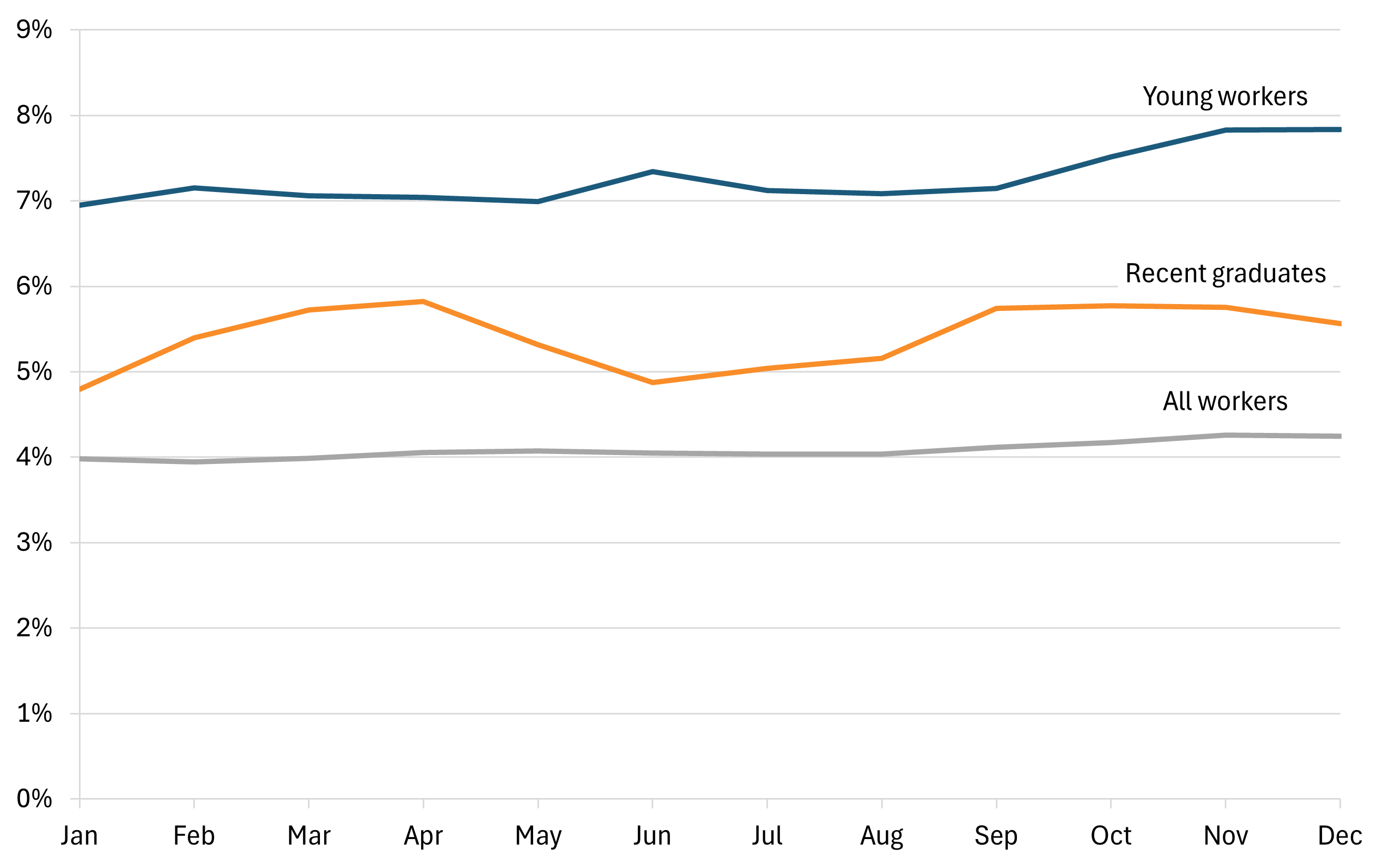
To start, Warner’s claim that the recent college graduate unemployment rate is 9 percent is wrong. According to the Federal Reserve Bank of New York, the unemployment rate for recent college graduates was 5.6 percent in December 2025. Across the full year of 2025, the recent graduate unemployment rate ranged between 5 and 6 percent—nowhere near 9 percent.
When compared to all workers, this 5 to 6 percent range isn’t much higher than the unemployment rate for all workers, which currently stands at about 4 percent. Even young workers without a bachelor’s degree have unemployment rates below Warner’s claim, ranging from 7 to 8 percent in 2025.
Next, Warner’s assertion that AI will lead to an unemployment rate of 30 to 35 percent is highly unlikely.
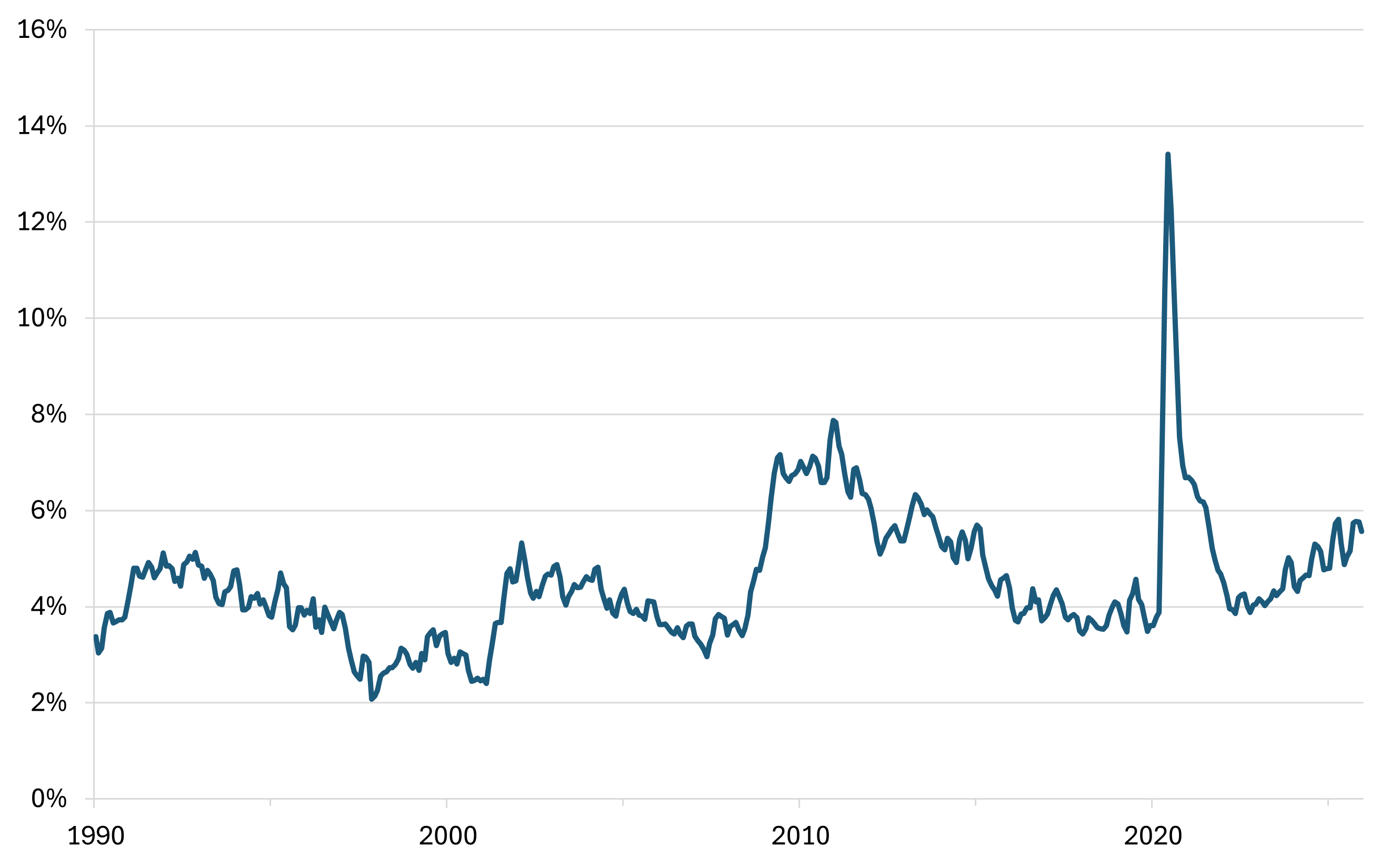
In the last 35 years, the highest recent graduate unemployment rate reached 13.4 percent in June 2020, driven by widespread shutdowns during the COVID-19 pandemic—not by technology. The recession in 2010 was the only other period of elevated unemployment for recent graduates, peaking at 7.9 percent.
Here’s what people need to firmly grasp: Even during severe economic shocks, the recent graduate unemployment rate was nowhere near 35 percent.
Warner’s prediction, and others like it, is a stretch. If anything, AI will lead to greater productivity and, subsequently, economic growth, which will have the opposite effect of the 2010 recession and the pandemic. Indeed, a study published this month found that firms adopting AI are experiencing labor productivity gains that are expected to strengthen in 2026.
This latest round of panic is, once again, first-order policy thinking at its worst. AI reduces some entry-level positions; therefore, the story ends there, and your kid lives in the basement forever. History suggests otherwise.
In fact, 10 years ago, when an increasingly large number of pundits and scholars began arguing that technology would soon lead to large-scale displacement of workers, I made a Long Bet: that by June 2025, the labor force participation rate would be above 60 percent and the unemployment rate would be below 7.5 percent.
Ten years later, I won that bet. Like I said then and have continued to say—be patient and don’t panic. Because no, robots won’t kill our jobs, emerging technology won’t cause long-term unemployment, and automation won’t result in net job losses.
Rather than fear technological change and automation, embrace it. Automation boosts productivity, and increased productivity lowers prices or raises wages, or sometimes both. In turn, lower prices and higher wages increase spending and investment, which ultimately create jobs, including entry-level ones. Oh, and we’ll all be richer too.
Thanks, good piece, very clear and plain language. As someone very much learning about economic theory, can you comment on potential wage compression (alongside increased AI productivity), or do your above points account for that implicitly?
At a high level, I agree we need a more optimistic, growth mindset for the incoming changes, but I still think AI's basic 'computer use ability' seeps into other 'non-white collar knowledge' sectors and employment rates subtly... (this coming from someone with years in various sector office admin, project work).
You write "...problems complex enough that AI simply can’t handle them: legislators, CEOs, antitrust attorneys..." but I follow AI progress closely, and I'd argue AI as of Apr 2026 (w/ monthly spend of $100s) can at least get close to human performance in legislative research, drafting, case building etc. (especially with fine tuned local datasets, regulations, cleverly appended in a Karpathy inspired LLM knowledge base).
For the macro changes to be less dramatic, accrediting and professional guilds and bodies need to allow for quicker career shifts (e.g. intensive fast track programs), casting a wider net, offering subsidised retraining, with a human focus on transferable skillsets, what makes you you etc etc.